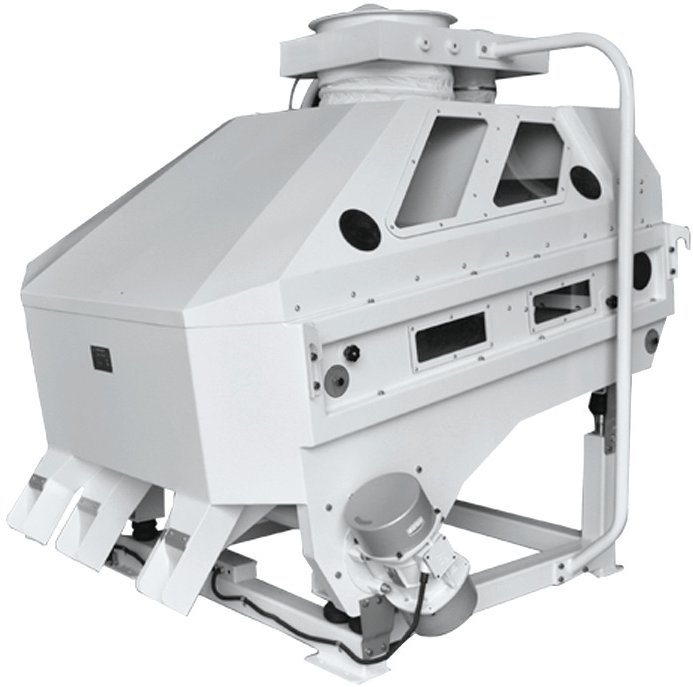
Primary cleaning · Model TQSF
Gravity Classifying Destoner
The machine that decides how much ash ends up in your flour.
- 60+ years manufacturing
- 10–500 t/d capacity range
- 100+ patents
- Turnkey commissioning
What it does
Stones are the same size as wheat and heavier, so only a combined air-and-vibration separation can lift them out. Skipping or under-sizing the destoner is the single most common cause of excessive ash in small mills — and the damage is invisible until a customer complains about grit.
Technical parameters
Nominal values at standard conditions. Confirm final specification on the order drawing.
| Model | Screen width (cm) | Capacity, wheat (t/h) | Air volume (m³/h) | Power | Weight | Dimensions (mm) |
|---|---|---|---|---|---|---|
| TQSF43 | 43 | 1–1.5 | 3,000 | 2 × 0.25 kW | 215 kg | 1270 × 700 × 1600 |
| TQSF50 | 50 | 2–4 | 4,000 | 2 × 0.25 kW | 230 kg | 1420 × 780 × 1800 |
| TQSF60 | 60 | 3–5 | 4,500 | 2 × 0.25 kW | 280 kg | 1450 × 876 × 1800 |
| TQSF80 | 80 | 5–7 | 6,000 | 2 × 0.25 kW | 340 kg | 1450 × 1046 × 1800 |
| TQSF100 | 100 | 7–9 | 8,000 | 2 × 0.25 kW | 400 kg | 1500 × 1246 × 1900 |
| TQSF125 | 125 | 9–11 | 10,200 | 2 × 0.25 kW | 500 kg | 1470 × 1496 × 1900 |
| TQSFB4125 | 125 | 15–18 | 12,000 | 2 × 0.55 kW | 650 kg | 1649 × 1714 × 2083 |
| TQSF150 | 150 | 11–14 | 12,000 | 2 × 0.25 kW | 600 kg | 1580 × 1746 × 1900 |
| TQSFB150 | 150 | 18–20 | 15,000 | 2 × 0.55 kW | 760 kg | 1649 × 1964 × 2083 |
| TQSF175 | 175 | 14–18 | 15,000 | 2 × 0.25 kW | 750 kg | 1470 × 1990 × 1900 |
| TQSF200 | 200 | 16–20 | 17,000 | 2 × 0.25 kW | 1,000 kg | 1470 × 2292 × 1900 |
| TQSF250 | 250 | 20–22 | 20,400 | 2 × 0.25 kW | 1,050 kg | 1470 × 2835 × 1900 |
Selection guidance
The "B" variants deliver roughly 60% more capacity on the same screen width by using a larger air volume and a steeper deck. Use them when floor space is the constraint rather than headroom.
Maintenance
Replace the screen cloth when stone removal efficiency drops below 95%; test quarterly by spiking a sample with 200 counted stones.
Selection cross-check
Destoning: dry gravity vs wet washer
Stone removal is mandatory. Whether you also wash is an economic decision driven by wheat dirt load and the flour market you serve.
This machine
Gravity Classifying Destoner
TQSF
Choose it when
Every dry cleaning line. Air classification plus a vibrating deck separates stones by density with no water, no effluent and no drying cost.
Watch out for
Cannot remove surface-borne dirt, bacteria or embedded sand. If your wheat is heavily soil-contaminated, dry destoning leaves the dirt on the grain.
Alternative
Wheat Washer, Destoner & Dryer
XMS / FZSQ
Choose it when
Wheat with high soil contamination, or when the flour must meet a low bacterial count or a premium ash specification. Washing removes surface dirt that no dry process reaches.
Watch out for
Adds 3–6% moisture that must be dried back, costing 8–15 kWh/t and requiring a centrifuge plus dryer. Produces effluent that needs treatment. Capital cost is 4–6× dry destoning.
Open Wheat Washer, Destoner & Dryer →Decision rule
Dry destoning is correct for clean wheat and standard flour. Wet washing earns its cost only where dirt load is high or the market pays a premium for low bacterial count.
Answers
Frequently asked questions
Straight answers to the questions engineers and mill owners actually ask us during plant sizing. If your case is not covered, send the wheat specification and your target tonnage.
Ask an engineer →- How do I know my destoner is working?
- Take a 1 kg sample from the stone outlet. It should be almost entirely stones and glass. If you see more than 10 wheat kernels per 100 stones, the air volume is too high or the deck angle is wrong.
- Why does ash matter so much?
- Ash is the mineral residue after burning — it is essentially a proxy for bran contamination. A patent flour at 0.55% ash and one at 0.70% ash look similar but behave very differently in a bakery and price 8–12% apart.
From the brochure
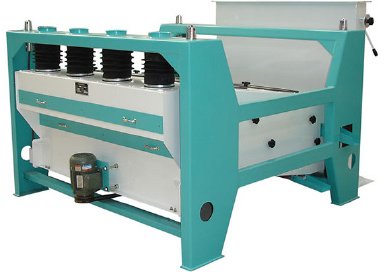
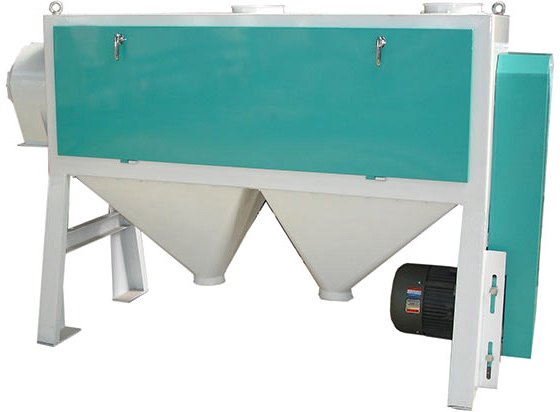
Gravity Classifying Destoner catalogue images
Photographs and parameter panels reproduced from the 2026 catalogue. Captions are the original brochure text.
Next step
Send your tonnage. Get a flow sheet in 12 working hours.
Send us: daily capacity target, wheat type and quality, available building dimensions, and local power supply. We reply within 12 working hours with a preliminary flow sheet, equipment list and budget range — no obligation.