Pillar handbook
Stone Milling Technology: The Complete Commercial Guide
How stone mills work, why 28–30 rpm preserves what roller milling destroys, the hybrid roller-plus-stone architecture, stone dressing intervals, and the commercial case for selling stone-milled flour at a 1.5–2× premium.
Key takeaways
- Stone mills turn at 28–30 rpm; roller mills turn at 550 rpm. That 20× speed difference is the entire thermal argument.
- Stone output per kW is roughly one fifth of a roller mill — which is why stone flour costs more, and why the premium market pays for it.
- The SFM-1+2 and SFM-3+4 hybridise: roller mills split and extract core, stone mills grind. Yield rises without losing the cold-grind character.
- Dress the stones every 300–500 operating hours. Undressed stones smear instead of cut, raising flour temperature and defeating the entire purpose.
- Stone flour sells at 1.5–2× roller flour in health-food channels, but the market absorbs volume slowly — match capacity to a distribution plan, not to ambition.
Stone milling survives commercially for one reason: heat.
Not tradition, not romance, not the texture. Heat. Every other claimed advantage of stone milling — flavour, nutrient retention, “natural” character — flows from the fact that a stone turning at 28–30 rpm puts a fraction of the thermal energy into the flour that a roller turning at 550 rpm does.
The thermal argument, quantified
A roller mill reduces wheat by passing it between two steel rolls turning at high speed with a differential. The work of reduction is concentrated in a very small gap, and the energy goes into the flour as heat. Flour leaving a reduction roll can sit at 45–60 °C.
A stone mill grinds by attrition between two abrasive surfaces moving slowly against each other. The same reduction work is spread over a much larger area and a much longer time. Flour leaving a stone mill typically sits at 5–15 °C above ambient.
Why does that matter? Because several things degrade with heat:
| Component | Degradation threshold | Roller milling | Stone milling |
|---|---|---|---|
| Carotenoids (colour, provitamin A) | ~40 °C | Significant loss | Minimal loss |
| Vitamin E (tocopherols) | ~50 °C | Significant loss | Minimal loss |
| B vitamins (thiamine, riboflavin) | ~60 °C | Partial loss | Minimal loss |
| Gluten network | ~45 °C | Partial denaturation | Intact |
| Starch granule structure | ~60 °C | Partial gelatinisation | Intact |
The often-quoted figure that stone flour contains 18× the carotenoids and vitamin E of roller flour is at the optimistic end of published measurements, but the direction and the mechanism are sound: cold grinding preserves what hot grinding degrades.
The commercial consequence is visible in the flour itself. Stone-milled whole wheat flour has a warm cream colour. Roller-milled whole wheat flour, even from the same wheat, is paler and greyer. A customer can see the difference in the bag.
What stone milling does to the flour’s behaviour
Nutrient retention is the marketing argument. Behaviour is the baking argument, and it is more consequential.
Particle size distribution. Stone grinding produces a wider distribution with a coarser mean. The flour retains a degree of grit — typically 70–85% passing 200 mesh versus 95%+ for roller flour. That grit changes water absorption, fermentation speed and crumb structure.
Starch damage. Roller milling deliberately damages a controlled fraction of starch granules to feed yeast. Stone milling damages less. The result is a flour that ferments more slowly and benefits from longer bulk fermentation.
Gluten integrity. Intact gluten from cold grinding hydrates differently. Bakers report a more extensible dough that is less prone to tearing during shaping, at the cost of slightly lower volume.
Bran in suspension. In whole wheat stone flour, the bran is in relatively large flakes rather than fine powder. Large flakes are visible in the crumb but do not cut the gluten network the way fine bran powder does. This is why stone-milled whole wheat bread often has better volume than roller-milled whole wheat bread at the same extraction.
The three architectures
Haiyun builds stone milling in three configurations, and the choice between them is about yield rather than philosophy.
Pure stone — SFM-100
A single stone pair with automatic feed and integrated sifting. Capacity 50 kg/h, 6 kW, footprint 3 × 2 × 3.2 m plus height.
This is the entry point. It runs whole wheat at 85–92% extraction, produces a genuinely cold-ground flour, and has the lowest capital cost of any configuration. It is also slow — 50 kg/h is 0.4 t over an 8-hour shift.
Use it for: a bakery adding a stone-milled SKU, a farm selling direct, a pilot line proving the market before scaling.
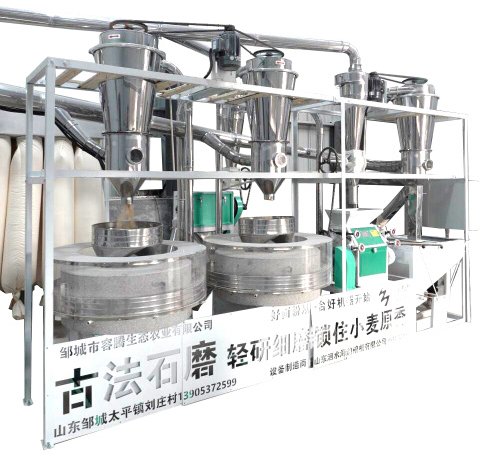
Hybrid 1+2 — SFM-1+2
One roller mill plus two stone mills. Capacity 200 kg/h, 21 kW, footprint 6 × 5 × 4 m.
The roller mill does the first break — it splits the wheat and releases core particles, which are then screened out and sent to the stone mills. The stone mills grind clean endosperm rather than whole kernels.
The effect: you keep the cold-grind character but raise yield and throughput. Rolling before stoning removes bran early, so the stones spend their limited capacity grinding endosperm instead of rubbing bran.
This is the configuration most commercial stone operations end up choosing. It is the compromise that makes stone milling economically viable at a scale beyond artisan.
Hybrid 3+4 — SFM-3+4
Three roller mills plus four stone mills. Capacity 600 kg/h, 80 kW, footprint 24 × 6 × 4.5 m.
Three roller mills extract the core in a single pass, with bran/core separation and double-bin flat sifting. Four stone mills then grind. The result is one-pass core extraction at 600 kg/h — high enough to supply a regional health-food distributor.
At this scale the plant is genuinely industrial, but the stones still turn at 28–30 rpm and the flour is still cold-ground. Verification requires hourly temperature logging; at 600 kg/h a stone that is not properly dressed will heat up fast.
Configuration comparison
| SFM-100 | SFM-1+2 | SFM-3+4 | |
|---|---|---|---|
| Capacity | 50 kg/h | 200 kg/h | 600 kg/h |
| Power | 6 kW | 21 kW | 80 kW |
| Footprint | 3 × 2 × 3.2 m | 6 × 5 × 4 m | 24 × 6 × 4.5 m |
| Roller mills | 0 | 1 | 3 |
| Stone mills | 1 | 2 | 4 |
| Extraction | 85–92% (whole) | 78–85% | 76–82% |
| kWh per tonne | ~120 | ~105 | ~133 |
| Typical buyer | Bakery, farm | Commercial stone miller | Regional distributor |
Note that specific energy does not fall monotonically — the SFM-3+4 has higher kWh/t than the SFM-1+2 because it adds three roller mills on top of four stones. The efficiency gain at that scale comes from labour and throughput, not from energy.
Stone dressing: the discipline that decides quality
A millstone is not a permanent grinding surface. It is a cutting tool that dulls.
Dressing (also called “sharpening” or “picking”) re-cuts the furrows on the stone face so that it cuts grain rather than smearing it. The interval matters:
| Operating condition | Dressing interval |
|---|---|
| Soft wheat, light load | 500 hours |
| Hard wheat, continuous | 300 hours |
| Whole wheat with high bran load | 250–300 hours |
| Any sign of flour temperature > 45 °C | Immediately |
Undressed stones produce flour that is hotter, coarser, and darker. The damage is gradual, so operators do not notice — they simply report that “the flour has changed” months later. Log stone temperature hourly and dress on schedule, not on symptoms.
The commercial case
Stone-milled flour sells at 1.5–2× the price of equivalent roller-milled flour in health-food, artisan bakery and export channels. That premium is real, but it comes with three constraints.
Constraint 1 — the market absorbs volume slowly. A health-food distributor might take 2 t a month. A premium bakery chain might take 5 t. If you install SFM-3+4 at 600 kg/h and run one shift, you produce 4.8 t a day — 100 t a month. You will not sell 100 t a month of premium stone flour in a market you have not built.
Match capacity to a distribution plan. Most buyers should start at SFM-1+2 and add capacity when the order book justifies it.
Constraint 2 — the premium is a marketing premium, not a technical one. You are not selling “flour”; you are selling a story about cold grinding, whole grain, and additive-free production. That story requires packaging, labelling, and a channel that repeats it. Without those, stone flour sells at commodity prices and the plant loses money.
Constraint 3 — stone flour has shorter shelf life. Whole wheat stone flour contains the germ, whose oils go rancid. Typical shelf life is 3–6 months at ambient versus 9–12 months for roller-milled white flour. Plan packaging sizes and distribution speed accordingly.
Where stone milling belongs
Stone milling is the correct choice when:
- You sell into a health-food, organic, or artisan channel that pays a premium
- You produce whole wheat or multigrain flour as a primary product
- You are a bakery adding a signature flour to your own products
- You serve an export market where “stone ground” has established value
It is the wrong choice when:
- You need volume at commodity pricing
- Your market cannot absorb a 40–100% price premium
- You need white patent flour at high extraction (roller milling wins decisively)
- Your operating team cannot maintain a dressing schedule
The hybrid configurations exist precisely to soften this trade. SFM-1+2 lets a commercial miller enter the premium market without abandoning yield. That is usually the right answer.
Articles in this handbook
- → SFM Stone Mill Configurations: 100, 1+2 and 3+4 Compared
- → Stone Dressing: Interval, Method and the Cost of Skipping It
- → Stone Mill vs Roller Mill: A Fair Comparison for Commercial Buyers
- → The Stone-Milled Flour Market: Who Pays the Premium and Why
- → Whole Wheat Flour Production: Extraction, Shelf Life and Process Choices