Turnkey — design, supply, installation, commissioning · 2021
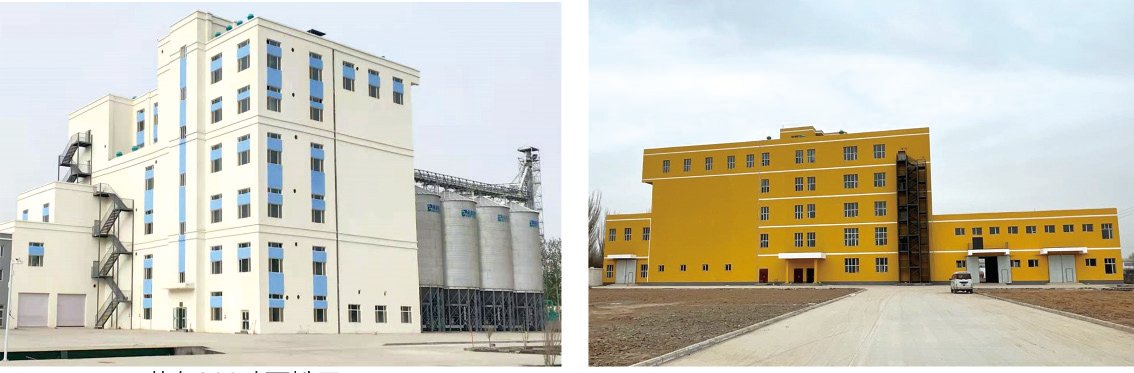
Yengisar 300 t/d flour plant
A storey-typed 300 t/d plant with a 4B5M1S1T flow sheet and a dedicated granular flour line, built for high-vitreous Xinjiang wheat and a local bread market that buys by the bag.
- 60+ years manufacturing
- 10–500 t/d capacity range
- 100+ patents
- Turnkey commissioning
Capacity
300 t/d
Installed power
920 kW
Specific power
67–71 kWh/t
Flow sheet
4B5M1S1T
Building
48 × 9 × 21 m
Extraction
76% patent + 4% clear
莎车 300 吨面粉厂 · Yengisar County, Kashgar Prefecture, Xinjiang, China
The brief
The client operated two 80 t/d plants and needed to consolidate into one site with capacity for a growing regional bread market. The requirement was not simply three times the tonnage: the market wanted a granular flour for a specific local flatbread, alongside a standard patent flour, from the same wheat intake.
Xinjiang wheat arrives at 11.5–13.5% moisture with high vitreousness and, in some lots, elevated falling number after wet harvests. The plant had to hold specification across that range without re-blending every week.
What constrained the design
Four constraints that shaped the plant more than the capacity figure did.
Two flour grades from one intake
A granular flour for flatbread and a standard patent flour cannot share the same reduction passages without compromise. The solution was to split after the 4th reduction: one stream continues to a dedicated granular reduction section, the other follows the standard patent path.
High-vitreous wheat
Vitreous wheat is harder and requires more grinding energy in the break passages. Roll gaps were set 0.02–0.03 mm wider than the standard reference for the first three breaks, and the break roll flutes were specified at 9 per inch rather than 10 to reduce bran shattering.
Falling number variability
Blending across three wheat silos was installed rather than planned as a later upgrade. Without it, a single high-alpha-amylase load would have gone straight into the mill and produced sticky-crumb flour that the local market would have rejected outright.
Cold winters
Kashgar winter ambient reaches −20 °C. The tempering bins are insulated and trace-heated, and the intake pit is enclosed. Without this, tempering water freezes on the wheat surface in January.
What was built
| Cleaning | Two parallel 15 t/h lines: drum sieve, self-balancing screen, gravity destoner, horizontal scourer, magnetic separation, automatic dampening to 16.0–16.5%. |
|---|---|
| Tempering | Six bins, 20 hours minimum, 24 hours standard. Insulated, trace-heated, individually instrumented. |
| Milling | 4B5M1S1T on eight FMFQ(S) double roller mills. Break rolls 250 × 1,000 mm, 9 flutes/inch, sharp-to-sharp. Reduction rolls 10–20 flutes/inch progressing to frosted on 4M and 5M. |
| Sifting | Two FSFG high square plansifters, 62 m² total sifting area — 0.83 t/d per m², at the upper end of the standard range. |
| Purification | Two FQFD purifiers in series, 6 sections each, feeding the granular line. |
| Bran recovery | Two FPDW bran finishers after the last break, recovering 1.8% of intake as flour-grade material. |
| Conveying | Bucket elevator and belt for wheat; pneumatic for flour to the two packing lines. |
| Packing | Two LCS lines: 25 kg woven bags at 12 bags/min, plus a 5 kg consumer line. |
Measured outcome
Commissioned in 11 weeks from mechanical completion to performance acceptance. The 72-hour test ran at 302 t/d average, 76.4% patent extraction and 68.9 kWh/t specific power — all within contract.
The granular line produces 42 t/d of flatbread flour at 0.52% ash. The patent line produces 186 t/d at 0.48% ash. Both run from the same wheat intake without a changeover.
Two years after commissioning the plant was running 24/5 with a five-day annual shutdown. Roll re-fluting was performed at 18 months on the first three breaks — earlier than the 24-month reference, which is expected on high-vitreous wheat.
What we would do differently
The honest section. Every project teaches something that was not in the specification.
- Splitting the flow sheet after 4M rather than building two separate plants saved roughly 22% of capital and 30% of the building footprint, at the cost of some flexibility in grade ratio.
- The blending system was the single most valuable addition. It was originally specified as a later upgrade and moved into the base scope during detailed design — the client now describes it as the reason the plant holds specification.
- Insulated tempering was not in the original specification. It was added after a site visit in February. Retrofitting it would have cost three times as much.
From the brochure
Next step
Planning a plant of this size?
Send us your target capacity, wheat specification and site constraints. We will tell you what a plant like this one would need — and what we would change if we built it today.